Cleavers Tincture: The Traditional Lymphatic Herb

Open almost any lymphatic formula and cleavers is on the label. It's the anchor herb of this entire category, and it has been for a very long time.
The plant
Galium aparine — also called goosegrass, sticky willy, catchweed, or bedstraw. A sprawling annual in the coffee family (Rubiaceae), covered in tiny hooked hairs that make it cling to clothing and animal fur; that's where "cleavers" comes from. It grows abundantly across Europe, Asia, and North America in hedgerows, waste ground, and gardens, usually treated as a weed.
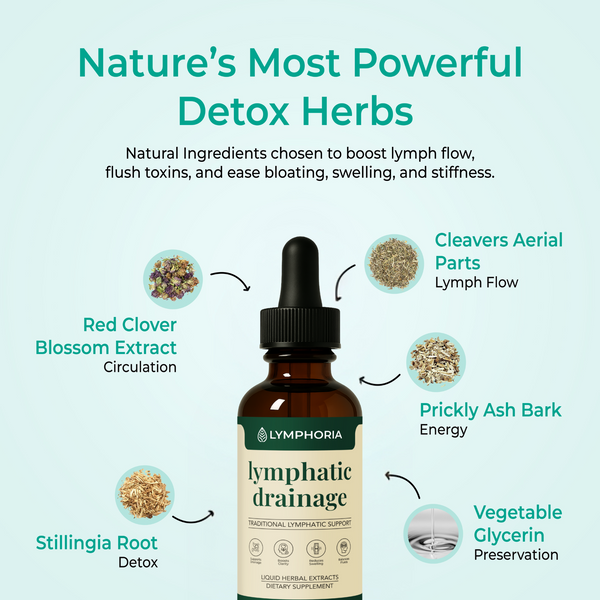
The parts used are the aerial parts — stems and leaves — harvested young in spring before flowering, when they're at their most succulent.
The traditional record
Cleavers appears in European herbal medicine going back centuries, consistently in the same role: a spring tonic for a system that felt "congested," and specifically for swollen glands and puffiness. Culpeper wrote about it in the 1600s. Nineteenth-century Anglo-American herbalists classed it as an alterative and a lymphatic, and modern Western herbalism has kept it in that exact slot.
Traditional uses recorded in the herbal literature include swollen lymph nodes, puffiness and fluid retention, skin complaints, and urinary tract support. In folk practice it was often taken as a spring juice or infusion — the young plant blitzed with water and drunk fresh.
What's in it
Iridoid glycosides (notably asperuloside), coumarins, flavonoids including luteolin, tannins, some anthraquinones in the root, and modest amounts of vitamin C. Interesting chemistry, but no single constituent has been established as "the active" for lymphatic use.
What the science actually says
Here's where honesty matters. There is essentially no modern clinical trial evidence for cleavers in humans for lymphatic function. What exists is a handful of laboratory and animal studies suggesting antioxidant and mild antimicrobial activity, and one small area of interest around anti-inflammatory effects of iridoids generally.
So the case for cleavers is a traditional-use case, not a clinical one. That's not nothing — centuries of consistent use in a specific role is real information — but it isn't proof, and any brand implying otherwise is stretching.
How it's taken
- Tincture — the most common form. Alcohol extraction, dropper-dosed. Typical traditional guidance is 2–4 ml, up to three times daily, though products vary widely — follow your label.
- Glycerite — alcohol-free, sweeter, gentler.
- Liposomal liquid — the extract wrapped in phospholipids, a delivery format used to improve uptake of compounds that absorb poorly.
- Fresh juice or infusion — the traditional spring preparation. Grassy, slightly bitter, not unpleasant.
- Dried tea — available, though cleavers is generally considered to lose potency on drying, which is why tinctures dominate.
Safety and cautions
Cleavers is regarded as gentle and is on the milder end of the herbal spectrum. Still:
- Avoid in pregnancy and breastfeeding — insufficient safety data.
- Speak to your doctor if you take diuretics or blood pressure medication; cleavers has traditional diuretic associations and the combination hasn't been studied.
- Caution with diabetes medication, as with most herbs, given theoretical additive effects.
- Possible allergy if you react to other Rubiaceae plants.
- Not a substitute for medical care in lymphedema, and not appropriate as self-treatment for persistently swollen lymph nodes — that needs a diagnosis.
Choosing a cleavers product
- Aerial parts specified, not just "cleavers."
- Extract ratio stated (e.g. 1:2 fresh, 1:5 dried) so a millilitre means something.
- Amount in milligrams or millilitres, not hidden in a proprietary blend.
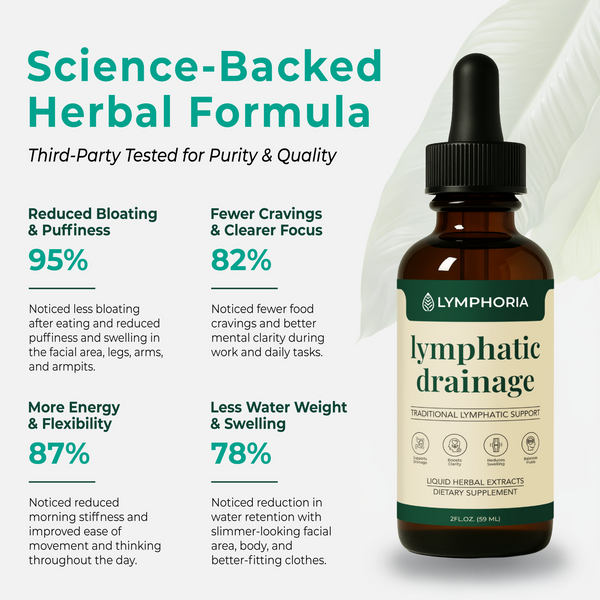
- Third-party testing for heavy metals and pesticides — cleavers is often wild-harvested from roadsides and waste ground, which is exactly where contaminants sit.
- Harvest timing mentioned is a good sign; spring-harvested pre-flowering is the traditional standard.
The bottom line
Cleavers is the traditional lymphatic herb, with centuries of consistent use and very little modern research. That combination should shape your expectations: reasonable to include in a daily routine, unreasonable to expect it to do the work that movement, hydration, and sleep do.

Cleavers, in a liposomal format
Lymsomal is built around the traditional lymphatic botanicals, with amounts listed on the label.
See the ingredientsThis article is for general education only and is not medical advice. Lymsomal is a dietary supplement and is not intended to diagnose, treat, cure, or prevent any disease. Persistently swollen lymph nodes should be assessed by a healthcare professional.