Red Clover and Circulation: What the Herb Is Used For

Red clover is the second name you'll find on most lymphatic formulas, and it's the one with the most actual research attached — though not in the area you might expect.
The plant
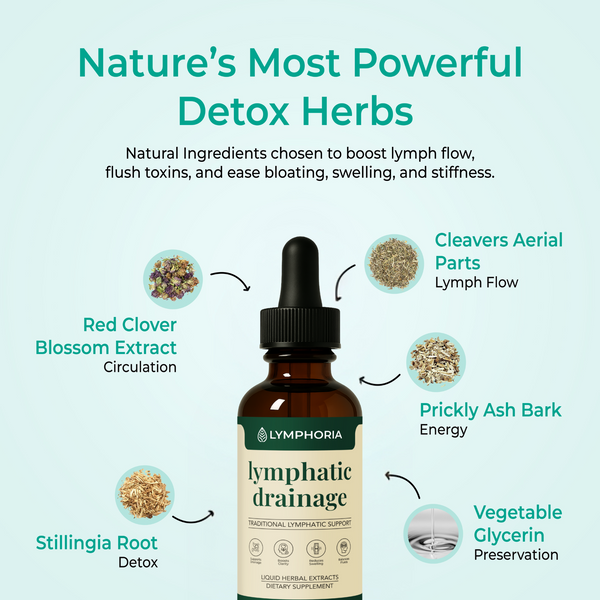
Trifolium pratense — a short-lived perennial legume with the familiar pink-purple flower heads, native to Europe and Asia and naturalised across North America. It's grown as a fodder crop and a nitrogen-fixing cover crop, which is why it grows everywhere. The flowering tops are the part used medicinally.
The traditional record
In Western herbalism red clover is classed as an alterative — a slow-acting tonic thought to improve the body's clearing and circulatory function over time. It appears alongside cleavers in nineteenth-century lymphatic and "blood cleansing" formulas, and in traditional use for skin conditions like eczema and psoriasis, coughs, and swollen glands.
The circulation and lymphatic associations come from this alterative tradition, not from trial data. Worth being clear about that upfront.
What's in it — and why that matters
Red clover is one of the richest dietary sources of isoflavones: genistein, daidzein, biochanin A, and formononetin. These are phytoestrogens — plant compounds structurally similar enough to oestrogen to interact weakly with oestrogen receptors.
That single fact drives both the research interest and the main safety caution.
Where the evidence actually is
Menopausal symptoms — the studied area
Multiple randomised trials and several meta-analyses have looked at red clover isoflavone extracts for hot flushes. Results are mixed but lean modestly positive: some analyses find a small reduction in hot flush frequency versus placebo, others find no significant effect. It's the best-researched use of the plant, and even here the effect is modest.
Bone density
Some trials suggest a small protective effect on bone mineral density in postmenopausal women. Preliminary, not established.
Cardiovascular markers
Small studies have examined arterial stiffness and lipid measures with mixed and inconsistent results. This is the closest thing to "circulation" evidence, and it is thin.
Lymphatic function
No human clinical evidence. Traditional use only.
Who should avoid or check first
This matters more for red clover than for most herbs in this category:
- Hormone-sensitive conditions — breast, ovarian, or uterine cancer, endometriosis, uterine fibroids. Because of the isoflavones, standard guidance is to avoid without medical supervision.
- Pregnancy and breastfeeding — avoid.
- Blood thinners (warfarin, and to a lesser degree others) — red clover contains coumarins and may increase bleeding risk. Check with your doctor.
- Surgery scheduled — stop at least two weeks beforehand for the same reason.
- Hormonal medication — contraceptives, HRT, tamoxifen. Theoretical interaction; ask your prescriber.
- Methotrexate and some liver-metabolised drugs — possible interactions reported.
Reported side effects in trials are generally mild: headache, nausea, rash, breast tenderness, spotting.
How it's taken
Tincture, glycerite, liposomal liquid, capsules of standardised isoflavone extract, or a simple infusion of the dried flowers. Trials on menopausal symptoms typically used 40–80 mg of isoflavones daily; general tonic use in herbal formulas is usually well below that. Follow your product label.
Reading a red clover label
- Flowering tops specified, not "herb" or "aerial parts" vaguely
- Isoflavone content stated if it's a standardised extract — this is the difference between a tonic dose and a study dose
- Amount disclosed, not buried in a blend
- Third-party tested for heavy metals and pesticides
The bottom line
Red clover has a genuine traditional place in lymphatic and circulatory formulas and a modest evidence base — for menopausal symptoms, not for drainage. Its isoflavone content is both the reason it's interesting and the reason a specific group of people should leave it alone. If you have any hormone-sensitive condition, take blood thinners, or are pregnant, check before you start.

See exactly what's in the bottle
Full ingredient amounts are listed on the Lymsomal product page — useful if you need to check against a medication.
View the labelThis article is for general education only and is not medical advice. Lymsomal is a dietary supplement and is not intended to diagnose, treat, cure, or prevent any disease. If you have a hormone-sensitive condition or take prescription medication, speak with a healthcare professional before using red clover.