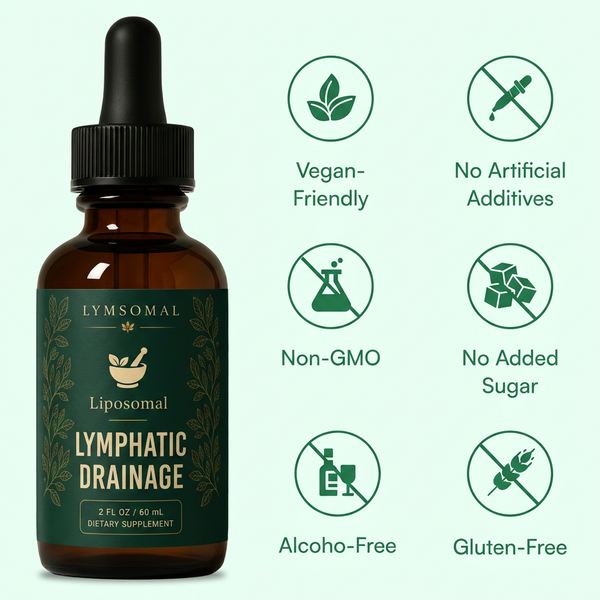
Lymsomal Lymphatic Drainage Drops: What They Are and How They Work

If you've landed here holding a bottle — or deciding whether to get one — this is the practical guide. What's inside, how to take it, and what to expect.
What Lymsomal is
Lymsomal is a liquid dietary supplement taken by mouth from a dropper. It combines botanicals traditionally associated with lymphatic and circulatory support in a liposomal format, designed as a ten-second daily ritual rather than another capsule to remember.
It is a supplement, not a medicine. It is not a diuretic, not a laxative, and not a treatment for any medical condition.
What "liposomal" means
A liposome is a microscopic bubble with a wall made of phospholipids — the same class of fat that makes up your own cell membranes. Because the wall is structurally similar to your cells, liposomes are a well-established delivery format in nutrition science for compounds that are otherwise poorly absorbed or unstable in the digestive tract.
In practical terms, liposomal formats are used to protect a botanical extract on its way through the gut and improve how much of it your body can take up, compared with the same extract in plain water. Worth saying plainly: absorption data varies a lot by compound and by manufacturer, so treat liposomal as a thoughtful formulation choice rather than a magic multiplier.
The botanicals, and their honest evidence status
- Cleavers (Galium aparine) — the classic lymphatic herb in Western herbal tradition, used for centuries in tonics for puffiness and sluggish drainage.
- Red clover (Trifolium pratense) — traditionally used as an alterative, often alongside cleavers in circulatory formulas.
- Prickly ash bark (Zanthoxylum) — traditionally used where circulation feels slow, with its characteristic tingling warmth.
- Stillingia root (Stillingia sylvatica) — a traditional North American alterative herb, historically paired with the above.
All four have a long traditional record and a thin modern clinical one. We'd rather tell you that than imply otherwise.
How to take the drops
- Shake the bottle. Liposomal liquids can settle; a few seconds of shaking gets you a consistent dose.
- Squeeze the dropper to the marked line for your serving size — follow the amount printed on your bottle's label, which is the authority here.
- Hold it under your tongue for about 20–30 seconds, then swallow. Or add it to a small glass of water if you'd rather skip the taste.
- Chase with water. Helpful for the taste, and hydration is doing real work in this routine anyway.
When
Morning, on an empty stomach, is the most common choice — partly for absorption, mostly because attaching it to an existing habit is what makes people actually take it daily. If mornings are chaotic, evening is fine. Consistency beats timing.
Storage
Cool, dry, out of direct sunlight. Cap on tight. Check your label for whether refrigeration after opening is recommended.
Stack it with the free stuff
The drops are a supporting player. The things that move lymph most are behavioural, and they cost nothing:
- A short walk every hour you're sitting
- Ten deep belly breaths, a few times a day
- Enough water — pale-straw urine as your gauge
- More potassium (greens, avocado, beans, potatoes), less processed sodium
- Legs elevated for 15 minutes before bed
People who pair the drops with two or three of these are the ones who report the clearest difference. That's not a coincidence.
What's realistic to expect
Botanical supplements are cumulative, not immediate. A sensible frame:
- Week 1–2: mostly habit-building. Some people notice they're drinking more water and moving more, which itself changes how they feel.
- Week 3–4: the window where most people who notice anything start to notice it — typically in how their face looks in the morning or how their legs feel by evening.
- Week 6–8: a fair point to judge whether it's earning its place in your routine.
Some people feel a difference quickly. Some feel nothing. Both are normal outcomes for a supplement, and anyone telling you otherwise is overselling.
Who should check with a doctor first
Talk to a healthcare professional before starting if you are pregnant or breastfeeding, taking blood thinners, blood pressure medication, or diuretics, have kidney, liver, heart, or thyroid conditions, have a hormone-sensitive condition, or have any persistent, painful, or one-sided swelling. Stop and seek advice if you notice a reaction of any kind.
The bottom line
Shake it, take it under the tongue, chase it with water, and pair it with walking and hydration. Give it six weeks before you decide. That's the whole method.

Start your daily ritual
Multi-bottle bundles bring the per-day cost down — useful, since six weeks is the honest window for judging any botanical.
Shop Lymsomal DropsThis article is for general education only and is not medical advice. Lymsomal is a dietary supplement and is not intended to diagnose, treat, cure, or prevent any disease. Always follow the dosage on your product label.