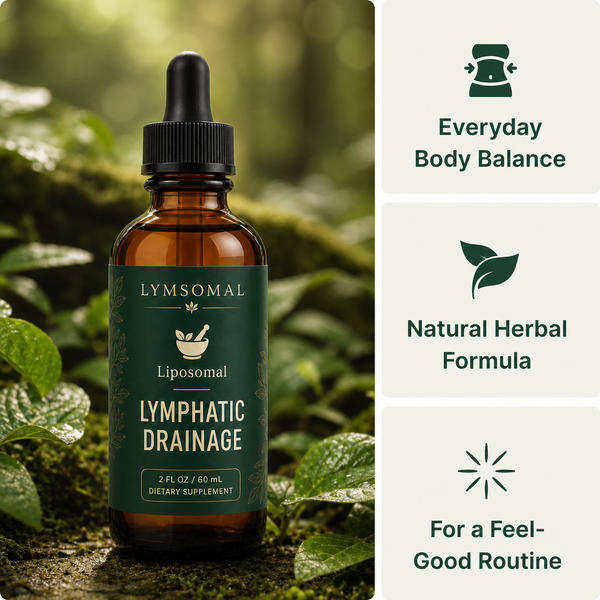
Lymsomal Drops: Ingredients, Results, and What to Expect

This is the ingredient-and-expectations breakdown, with the evidence status attached to each item rather than buried in a footnote.
The ingredients
Cleavers (Galium aparine), aerial parts
Traditional role: the anchor herb of the Western lymphatic tradition. Used for centuries as a spring tonic for swollen glands and puffiness, classed as a lymphatic and alterative.
Evidence status: centuries of consistent traditional use; essentially no modern human clinical trials for lymphatic function. Lab work suggests antioxidant and mild antimicrobial activity.
Red clover (Trifolium pratense), flowering tops
Traditional role: alterative, paired with cleavers in nineteenth-century circulatory and lymphatic formulas.
Evidence status: the best-studied herb here — but the trials are on menopausal hot flushes (mixed, modestly positive) and bone density (preliminary), not drainage. Contains isoflavones, which is why it carries a caution for hormone-sensitive conditions.
Prickly ash bark (Zanthoxylum)
Traditional role: circulatory stimulant — the "driver" herb in traditional formulas, used where circulation felt cold and sluggish.
Evidence status: traditional use plus laboratory studies showing vasorelaxant and anti-inflammatory activity. No meaningful human trials. Produces a mild tingling sensation, which is expected and harmless.
Stillingia root (Stillingia sylvatica)
Traditional role: alterative in nineteenth-century American herbal practice, a small supporting fraction in traditional compound formulas.
Evidence status: very limited. Included at a supporting dose, as the tradition indicates — higher amounts are irritant to the gut.
The liposomal carrier
Phospholipids — the same class of fat as your cell membranes — forming microscopic bubbles around the extract. This is an established delivery format for protecting compounds through the digestive tract and improving uptake. Sensible engineering; the magnitude of the benefit varies by compound and manufacturer, so we won't quote you an absorption multiplier.
The summary you should take from that
Four botanicals with a long traditional record in exactly this role, and a thin modern clinical record. That's the accurate picture, and it's the same picture for every product in this category regardless of how the marketing reads.
What to expect, week by week
Week 1
Mostly habit-building. You may notice you're drinking more water and moving more simply because taking the drops reminds you to. That's a real effect, and it's coming from the behaviour rather than the bottle.
Week 2
The routine settles. Nothing dramatic. Some people notice the tingle from prickly ash and wonder if something's wrong — it isn't.
Weeks 3–4
The usual window if you're going to notice something. What people typically report: their face looks less puffy in the morning, or their legs feel less heavy by evening. Small and gradual rather than sudden.
Weeks 6–8
A fair point to decide. Six weeks of consistent use, paired with at least one behaviour change, is a real test.
How to actually tell whether it's working
Memory is unreliable, especially for something gradual. Use something concrete:
- Morning photo — same spot, same light, same time. Weekly, not daily.
- Ring or watch test — do they fit at 6pm the way they do at 9am?
- Sock line check — how long does the mark take to fade?
- A 1–5 evening rating for how heavy your legs feel. Ten seconds a day, and far more honest than recall.
- Weight at the same time daily if fluid is your issue — watching the pattern, not the number.
What will not happen
- A visible change in 48 hours. That's a diuretic effect, and we don't include diuretics.
- Fat loss. It isn't a weight-loss product.
- "Toxins" leaving your body. That's not how the lymphatic system works, and your liver and kidneys already handle it.
- Improvement in lymphedema. That's a medical condition requiring certified manual lymphatic drainage and compression therapy.
What multiplies the effect
Rough order of impact, and none of it costs anything:
- Move every hour you're sitting — sixty seconds is enough
- Enough water; pale-straw urine as your gauge
- More potassium (greens, avocado, beans, potatoes), less processed sodium
- Enough protein
- Sleep
- Legs elevated 15 minutes in the evening
- Compression socks if you sit, stand, or travel for work
- Ten deep belly breaths, a few times daily
Who should check with a doctor first
Pregnancy or breastfeeding; blood thinners; blood pressure medication or diuretics; kidney, liver, heart, or thyroid conditions; hormone-sensitive conditions (red clover); surgery scheduled within two weeks; lithium or diabetes medication; or any persistent, painful, or one-sided swelling.
The bottom line
Four traditional botanicals in a liposomal format, honest about a thin evidence base, cumulative over about six weeks, and considerably more effective when paired with walking and water. Track something concrete, judge at week six.

Enough for the full six weeks
Bundles cover the honest evaluation window at a lower cost per day.
Shop Lymsomal DropsThis article is for general education only and is not medical advice. Lymsomal is a dietary supplement and is not intended to diagnose, treat, cure, or prevent any disease. Always follow the dosage on your product label.